

In the world of electronics and testing equipment, understanding the nuances of a DC power supply is crucial for engineers, hobbyists, and professionals alike. When selecting a DC power supply, two key specifications often come into play: accuracy and resolution. These terms are frequently confused, but they represent distinct aspects of performance that can significantly impact your projects. In this article, we'll break down the differences between DC power supply accuracy and resolution, why they matter, and how to choose the right device for your needs. Whether you're powering sensitive circuits or conducting precise measurements, grasping these concepts ensures reliable results.
What is Resolution in DC Power Supplies?
Resolution refers to the smallest increment by which the output voltage or current of a DC power supply can be adjusted or displayed. It's essentially the granularity of control you have over the settings. For instance, a power supply with a resolution of 1 mV means you can fine-tune the voltage in steps of 0.001 volts, allowing for precise adjustments in applications like circuit prototyping or sensor calibration.
High resolution is particularly valuable in scenarios requiring minute changes, such as in research labs or when testing low-power devices. Without adequate resolution, you might not achieve the exact output needed, leading to inconsistencies in your work. Many modern programmable DC power supplies offer impressive resolution, enabling users to dial in values with exceptional detail.
To visualize a typical DC power supply in action, consider this example of a device designed for versatile lab use.

Devices like these often feature digital interfaces that display resolution clearly, helping users monitor and adjust outputs effectively.
What is Accuracy in DC Power Supplies?
Accuracy, on the other hand, measures how closely the actual output of the DC power supply matches the set or displayed value. It's typically expressed as a percentage of the full scale or a combination of percentage and fixed error (e.g., ±0.5% + 5 mV). High accuracy ensures that the voltage or current delivered is reliable and true to your intentions, minimizing errors in experiments or device operation.
In practical terms, even if a power supply has excellent resolution, poor accuracy could mean the output deviates from what you expect. This is critical in fields like medical device testing or aerospace electronics, where precision can affect safety and performance. Factors like temperature drift, load regulation, and line regulation all influence accuracy.
For a clearer understanding, here's an illustration comparing resolution and accuracy concepts, adapted from similar technical contexts.
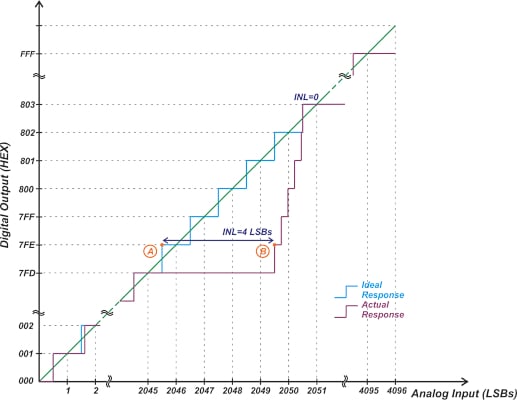
As shown, resolution deals with the steps, while accuracy focuses on hitting the target value precisely.
Key Differences Between Accuracy and Resolution
While both accuracy and resolution contribute to the overall performance of a DC power supply, they address different facets:
- Resolution is about the fineness of control and measurement. It's the "how small can I adjust?" aspect.
- Accuracy is about fidelity to the intended value. It's the "how close is it to what I set?" question.
To put it simply, resolution determines the steps on a ladder, while accuracy ensures you're climbing the right ladder. In high-end DC power supplies, you'll often find a balance of both, but prioritizing one over the other depends on your application. For example, in digital signal processing, high resolution might be key, whereas in power electronics testing, accuracy takes precedence.
Why Accuracy and Resolution Matter in Your DC Power Supply Choice
Choosing a DC power supply with the right balance of accuracy and resolution can prevent costly mistakes and enhance efficiency. Low resolution might lead to imprecise tuning, causing circuit failures or inaccurate data. Similarly, insufficient accuracy could result in unreliable outputs, affecting everything from battery charging to LED driving.
For professionals seeking top-tier options, brands like Kiprim offer programmable DC power supplies that excel in both metrics. Consider the Kiprim DC310Pro 2-in-1 Programmable Power Supply and Multimeter (0-30V/0-10A), which combines high resolution for fine adjustments with solid accuracy for dependable performance. Another excellent choice is the Programmable DC Power Supply (0-30V/0-10A, 110V Input), ideal for benchtop use.
For higher voltage needs, check out the Kiprim DC605Pro 2-in-1 Programmable Power Supply (0-60V/0-5A) or the Kiprim DC605S Programmable DC Power Supply (0-60V/0-5A, 110V Input). If you require more power, the Kiprim DC620S Programmable 400W DC Power Supply (0-60V/0-20A) delivers robust capabilities without compromising on precision.
Selecting the Best DC Power Supply for Your Needs
When shopping for a DC power supply, evaluate your requirements based on the projects at hand. Look for specifications that detail both accuracy (e.g., ±0.1%) and resolution (e.g., 1 mV/1 mA). Reading user reviews and datasheets can provide insights into real-world performance.
Explore the full range of Kiprim's DC power supplies at their DC collection page to find models that suit various budgets and applications. Investing in a quality unit with strong accuracy and resolution will pay off in reliable, repeatable results.
In summary, mastering the distinction between DC power supply accuracy and resolution empowers you to make informed decisions, ensuring your electronics work performs at its best. Whether for hobbyist tinkering or professional engineering, these specs are the foundation of precision power delivery.
0 Kommentare