

Selecting the right DC power supply for your laboratory setup is essential for engineers and researchers working on electronics prototyping, circuit testing, device validation, or R&D projects. In 2026, lab-grade DC power supply emphasize precision, programmability, safety protections, and reliable output stability to support increasingly complex experiments.
This guide helps you choose the best option tailored to professional lab environments, highlighting key differences from casual DIY use and recommending standout models from Kiprim.
Lab vs. DIY Requirements: Why Professional Matters
DIY or hobbyist setups often prioritize affordability and basic functionality. A simple adjustable supply (e.g., 0-30V/5A) might suffice for occasional Arduino projects, LED testing, or basic repairs. These tend to have lower accuracy, higher ripple/noise, and minimal protections—adequate for non-critical tasks but risky for sensitive components or repeatable measurements.
Professional lab/engineering environments, however, demand:
- High precision and low noise for accurate testing of analog circuits, sensors, or low-power devices.
- Programmability for automated sequences, waveform simulation, or long-term stability tests.
- Robust protections (OVP, OCP, OTP, short-circuit) to safeguard expensive prototypes and equipment.
- Reliable readback, data logging, or PC integration for documentation and compliance.
- Clean, stable output with fast transient response for dynamic loads.
In labs, poor power quality can introduce measurement errors, damage DUTs (devices under test), or invalidate results—making investment in a quality supply worthwhile.

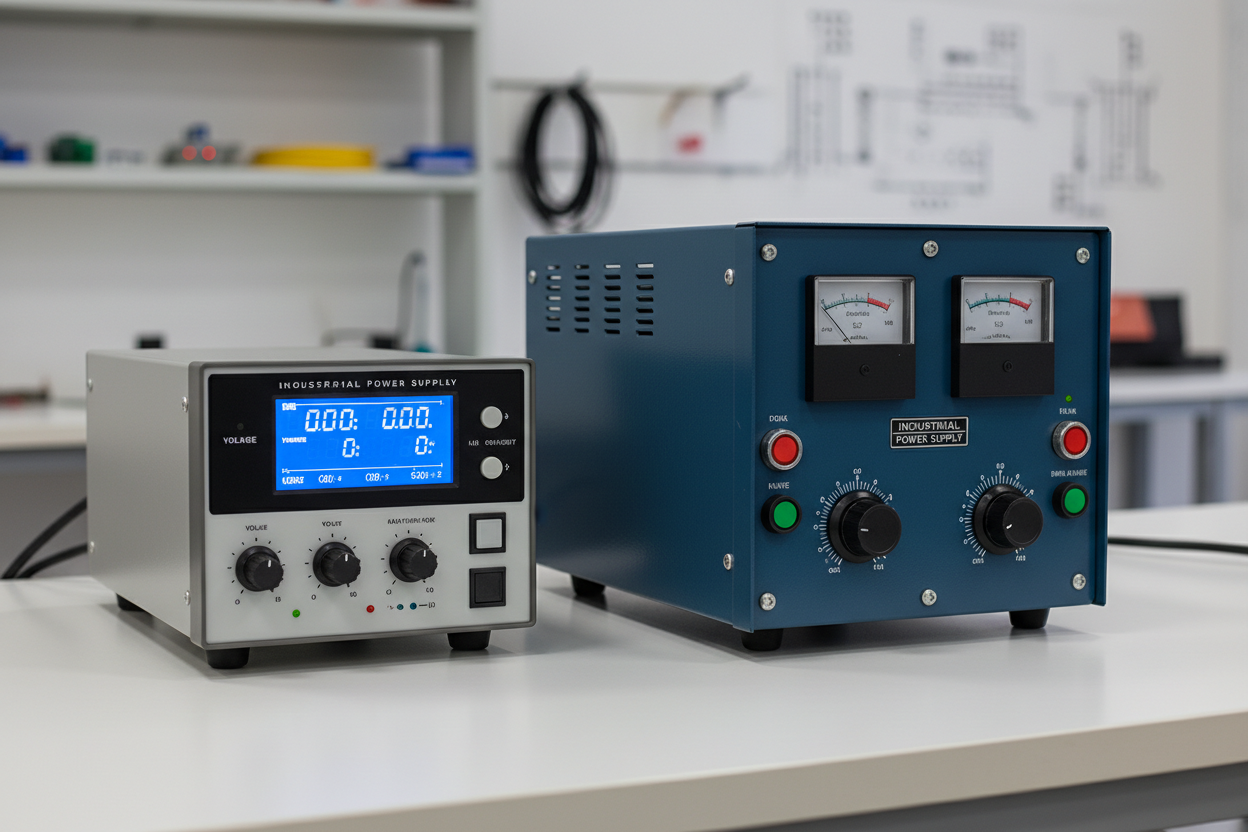
(Images: Professional benchtop DC power supplies in lab settings vs. compact models on workbenches)
Key Factors: Power, Precision, and Features to Prioritize
- Voltage and Current Range Most electronics labs start with 0-30V/0-10A (common for ICs, PCBs, and modules). For higher-voltage needs (e.g., power electronics, automotive testing, or LED drivers), opt for 0-60V or higher. Ensure the supply covers your maximum expected requirements with some headroom.
- Power Rating Calculate max power (V × A). A 300W unit handles most tasks; 400W+ suits demanding loads without derating.
- Precision and Resolution Look for 4-digit displays, high accuracy (e.g., <0.1% error), and fine adjustment. Low ripple/noise (<1mV rms) is crucial for sensitive analog work.
- Programming and Control USB/PC connectivity, memory presets, and list mode (for sequenced outputs) enable automation and repeatability—key for lab efficiency.
- Safety and Usability Multiple protections, output on/off switch, smart cooling, and clear interfaces reduce risks and improve workflow.
- Other Nice-to-Haves USB charging ports, curve displays for monitoring, and compact footprints for crowded benches.
Recommended Kiprim Models for Lab Use in 2026
Kiprim offers programmable, high-value DC power supplies designed with lab engineers in mind—balancing performance, features, and affordability.
- Kiprim DC310S (0-30V / 0-10A, ~300W class) Ideal for standard lab bench tasks like powering circuits, testing prototypes, or sensor calibration.4-digit precision display with numerical + curve modes for real-time visualization.Programmable via USB with PC software, list waveform output, and 4 memory presets (M1-M4).Protections: User-settable OVP (up to 31V), OCP (up to 10.1A), overheat (85°C).Extras: Front USB 5V/1A charging, output enable button, smart fan. Perfect for most electronics engineers needing reliable, feature-rich performance without excess power.

(Close-up of Kiprim DC310S front panel with vibrant display and controls)
- Kiprim DC620S (0-60V / 0-20A, 400W) For higher-power or voltage-demanding applications, such as power device testing, battery simulation, or multi-rail systems.2.8-inch full-color LCD with dynamic curves and real-time monitoring.USB PC control for remote adjustments and data logging.Comprehensive protections: OVP, OCP, OTP, short-circuit.4 memory slots and smart cooling for extended operation. Compact yet powerful, making it suitable for advanced lab setups requiring more headroom.
These models deliver professional-grade features like programmability and safety at competitive prices, making them excellent choices for 2026 lab upgrades.
Final Tips for Your Lab Setup
- Start with your typical voltage/current needs and add 20-30% margin.
- Prioritize programmability if you run repeated tests or need automation.
- Always verify low-noise output for analog-sensitive work.
- Pair with quality cables and probes for best results.
For detailed specs and to explore these models, visit:
- Kiprim DC310S: https://kiprim.com/products/programmable-dc-power-supply-0-30-v-0-10-a-110v-input
- Kiprim DC620S: https://kiprim.com/products/kiprim-dc620s-programmable-400w-dc-power-supply-0-60-v-0-20-a
Investing in the right DC power supply enhances accuracy, safety, and efficiency in your lab—empowering better engineering outcomes.
0 Kommentare