

In the realm of electrical engineering, achieving a clean and stable DC output is paramount for powering sensitive electronics, from precision analog circuits to high-speed digital systems. However, no DC power supply is perfect—residual AC components often manifest as ripple and noise, which can degrade performance or even cause system failures. This article delves into the technical aspects of ripple and noise in DC power supply, their origins, measurement techniques, and mitigation strategies. Whether you're designing RF amplifiers, testing ADCs, or prototyping embedded systems, understanding these phenomena is crucial for selecting and using the right benchtop power supply.
Understanding Ripple in DC Power Supply
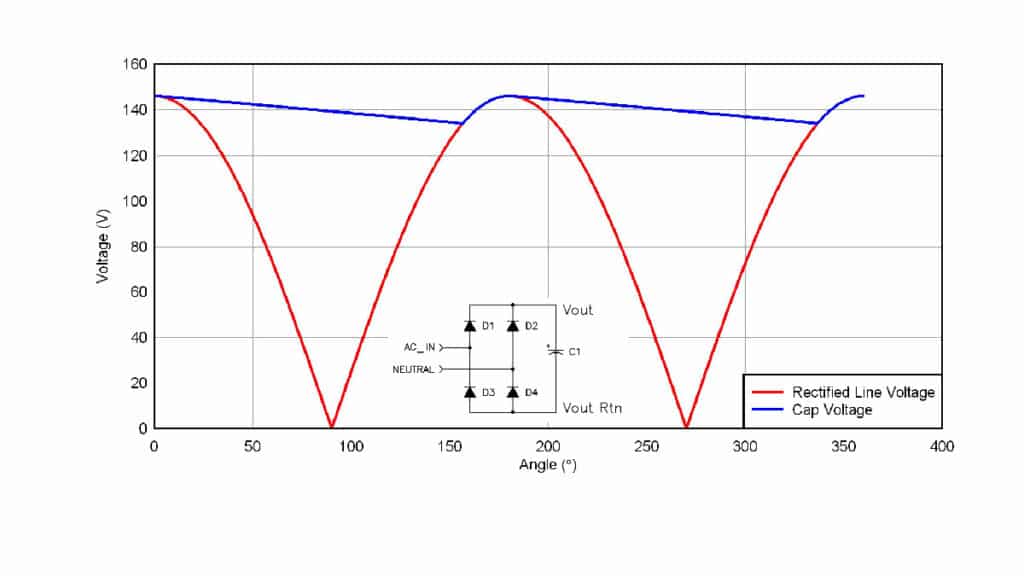
Ripple refers to the periodic AC voltage superimposed on the DC output, typically resulting from incomplete filtering in the rectification and regulation stages of the power supply. In linear power supplies, ripple often stems from the 50/60 Hz mains frequency or its harmonics after full-wave rectification. Switching-mode power supplies (SMPS), on the other hand, exhibit higher-frequency ripple due to their PWM switching action, often in the range of 10 kHz to several MHz.
Mathematically, ripple is quantified as the peak-to-peak (Vpp) or RMS value of the AC component relative to the DC level. For instance, a supply with a 12V DC output and 50 mVpp ripple has a ripple factor of approximately 0.42% (calculated as (Vpp / VDC) × 100%).
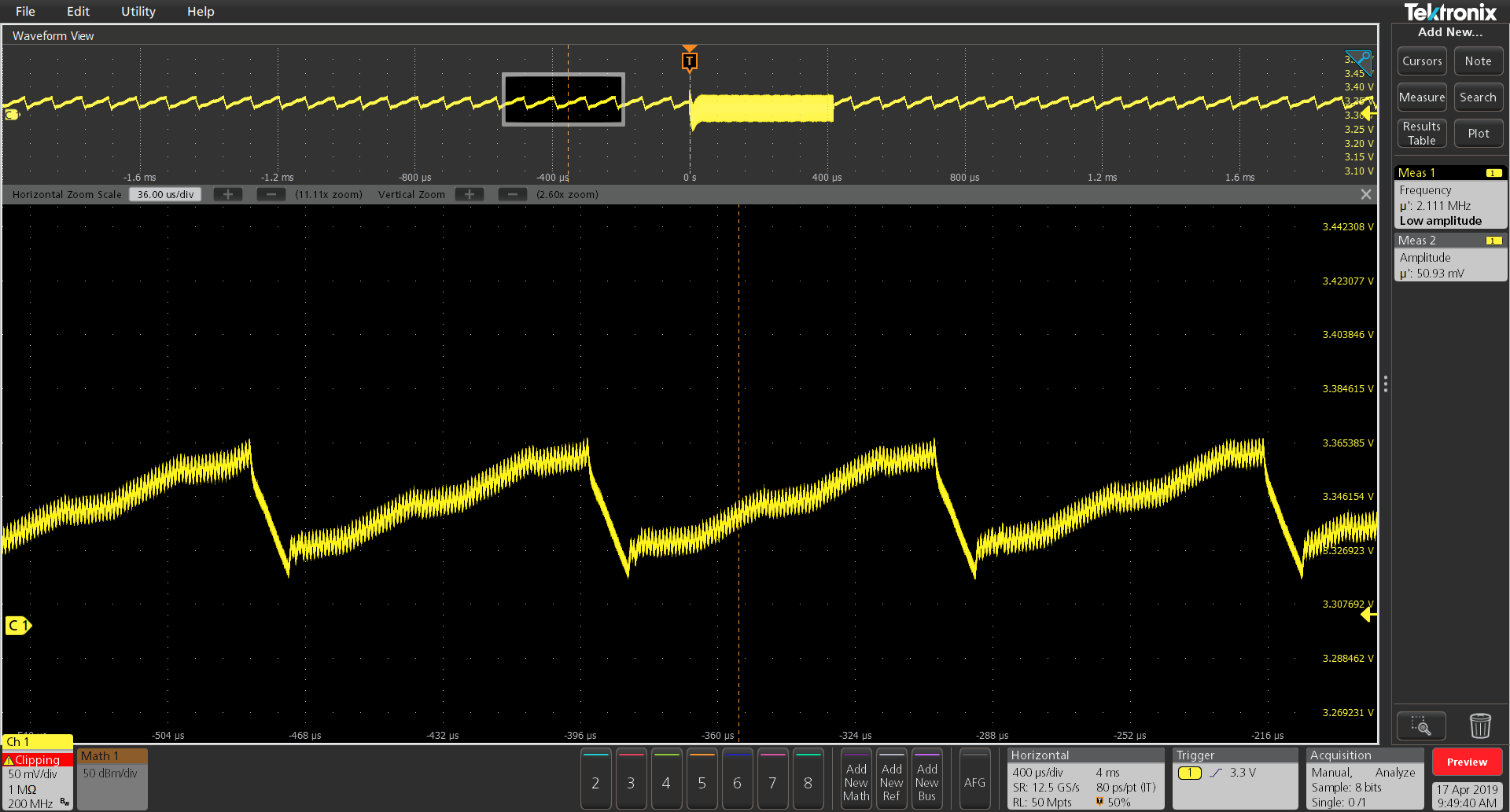
To visualize, here's an oscilloscope capture of typical ripple on a DC output waveform:

- Inadequate filtering capacitors: Undersized or aged electrolytics fail to smooth the rectified waveform.
- Load variations: Sudden current draws can exacerbate ripple in supplies with poor load regulation.
- Switching artifacts: In SMPS, insufficient output inductance or capacitance leads to pronounced ripple.
Measurement typically involves an oscilloscope with AC coupling, a low-noise probe (e.g., 1:1 passive probe with ground spring to minimize loop inductance), and bandwidth limiting to isolate ripple from broadband noise. Aim for measurements at full load for realistic specs.
What About Noise in DC Power Supply?
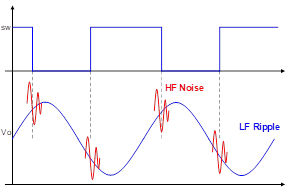
Noise, unlike the deterministic ripple, encompasses random, aperiodic fluctuations in the output voltage. It can be broadband (white noise) or narrowband (spikes from EMI/RFI). Sources include thermal noise from resistors, shot noise in semiconductors, and external interference coupled through the supply lines. In SMPS, high-frequency switching transients contribute significantly to noise, often appearing as spikes or bursts.
Noise is usually specified in terms of RMS voltage over a defined bandwidth (e.g., 20 Hz to 20 MHz), with values under 1 mV RMS being desirable for low-noise applications like audio preamps or sensor interfaces.
An oscilloscope trace highlighting noise on a DC supply might look like this:


To differentiate: Ripple is cyclical and predictable, while noise is stochastic. Combined, they form the total "ripple and noise" spec (often abbreviated as PARD - Periodic and Random Deviation).
The Impact of Ripple and Noise on Circuits
High ripple can cause:
- Hum in audio systems: 120 Hz artifacts from rectification.
- Instability in regulators: Feedback loops may oscillate.
- Data errors in ADCs/DACs: Sampling jitter or reduced SNR.
Noise affects precision measurements, introducing errors in op-amp circuits or degrading PSRR (Power Supply Rejection Ratio) in ICs. For example, in a 16-bit ADC with a 5V reference, 1 mV noise could limit effective resolution to 12-13 bits.
Compare low-ripple vs. high-ripple outputs in this illustrative diagram:
How to Minimize Ripple and Noise
- Choose linear supplies for ultra-low noise in sensitive apps, though they sacrifice efficiency.
- Opt for low-ESR capacitors and multi-stage filtering in designs.
- Use shielding and grounding: Ferrite beads on output leads suppress EMI.
- Select supplies with tight specs: Look for <20 mVpp ripple and <1 mV RMS noise.
- Post-regulation: Add LDOs or LC filters downstream for critical rails.
In lab settings, programmable DC power supply with advanced regulation (e.g., four-wire sensing) excel at maintaining low ripple/noise under varying loads.
Why Kiprim DC Power Supply Excel in Low Ripple and Noise Performance
Kiprim's programmable benchtop DC power supply are engineered with high-quality components, including low-ESR output capacitors and precision voltage references, achieving ripple and noise specs as low as 1 mV RMS / 3 mVpp—ideal for EE professionals demanding clean power.
Explore our lineup, featuring models with excellent line/load regulation (<0.01% + 3 mV) and built-in protections:
- Full DC Power Supply Collection — Browse all options for your lab needs.
- Kiprim DC310Pro 2-in-1 Programmable Power Supply & Multimeter (0-30V/0-10A) — Integrated multimeter for real-time ripple monitoring.
- Programmable DC Power Supply (0-30V/0-10A, 110V Input) — High-current with minimal noise.
- Kiprim DC605Pro 2-in-1 Programmable (0-60V/0-5A) — Extended voltage range for versatile testing.
- Kiprim DC605S Programmable (0-60V/0-5A, 110V Input) — Compact design with superior filtering.
- Kiprim DC620S Programmable 400W (0-60V/0-20A) — High-power option for demanding loads.
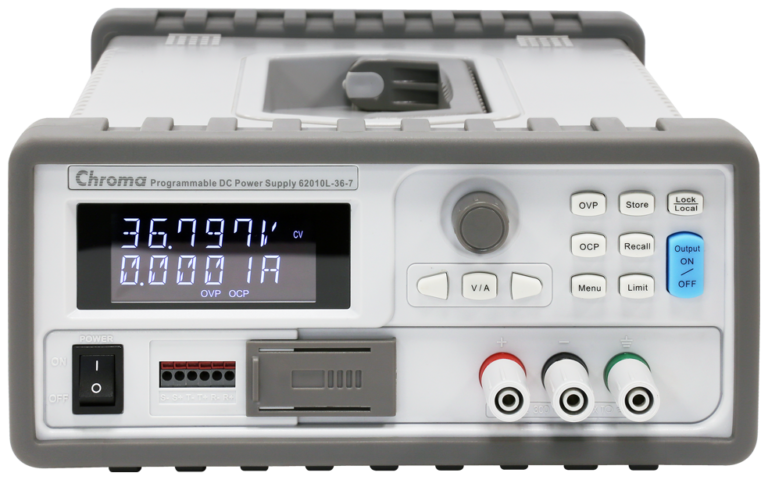
Here's a Kiprim model showcasing its low-ripple design in a typical bench setup:

By prioritizing low ripple and noise in your DC power supply choice, you ensure reliable performance in critical applications. For more technical insights or custom recommendations, reach out to the Kiprim team.
Stay powered precisely! ⚡
0 Kommentare